
Abacus vs Vedic Maths: Which One Should Your Child Learn First?
As parents become increasingly focused on their children’s academic and cognitive development, two educational programs frequently come into the spotlight: Abacus and Vedic Maths.
Both are known for improving calculation speed and mathematical abilities.
Both claim to strengthen mental arithmetic skills.
Both have helped thousands of children gain confidence in mathematics.
However, many parents find themselves asking an important question.
Which one should my child learn first?
Should I enroll my child in an abacus program or a Vedic Maths course?
Is one better than the other?
Can children learn both?
The answer depends on your child’s age, learning stage, and educational goals.
In this comprehensive guide, we will compare Abacus and Vedic Maths in detail to help parents make an informed decision.
Understanding Abacus
The abacus is one of the oldest calculation tools in human history.
Modern abacus programs use a specially designed frame with beads to teach arithmetic calculations.
Children begin by using a physical abacus.
As they progress, they learn to visualize the abacus in their minds.
Eventually, they perform calculations mentally without any physical tool.
This process is known as Mental Abacus.
The primary focus of abacus training is not only mathematics.
It is also designed to improve brain development, concentration, visualization, memory, and confidence.
Understanding Vedic Maths
Vedic Maths is a system of mathematical techniques derived from ancient Indian mathematical principles.
It consists of various shortcuts and formulas known as sutras.
These techniques simplify complex calculations.
Students learn faster methods for multiplication, division, percentages, squares, cube roots, and other mathematical operations.
Unlike abacus, Vedic Maths does not use any physical tool.
The emphasis is on understanding patterns and applying calculation shortcuts.
The primary objective is faster mathematical problem-solving.
The Main Difference Between Abacus and Vedic Maths
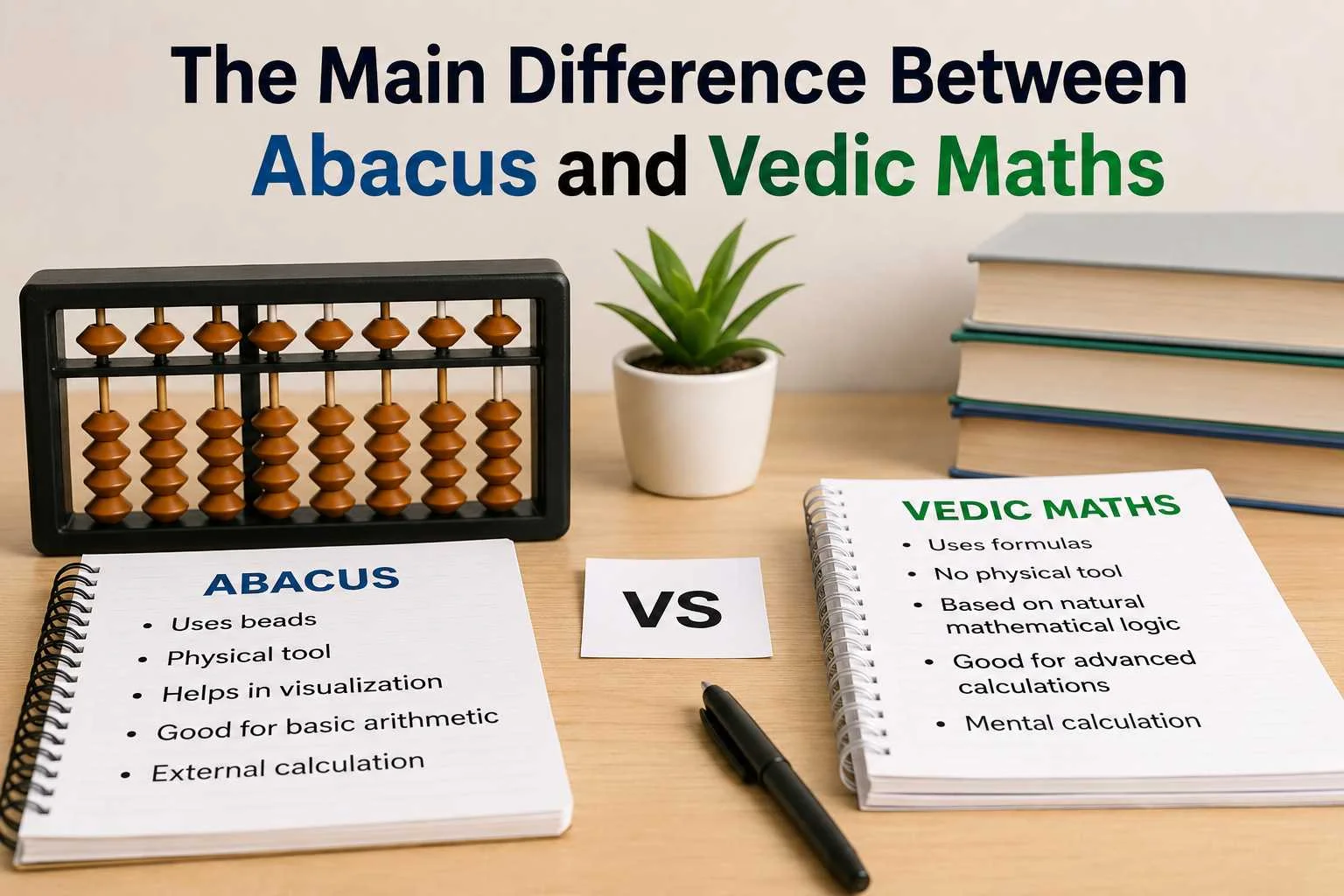
Although both improve calculation abilities, their approach is completely different.
Abacus focuses on cognitive development through visualization.
Vedic Maths focuses on mathematical shortcuts and techniques.
Abacus trains the brain.
Vedic Maths trains mathematical efficiency.
This distinction is important because parents often assume both programs serve the same purpose.
In reality, they complement each other rather than compete directly.
How Abacus Works
Children learn calculations by physically moving beads.
Repeated practice helps them develop a mental image of the abacus.
Over time, they perform calculations entirely in their minds.
This visualization process activates multiple areas of the brain.
Students improve concentration, memory, observation skills, and mental agility.
The training strengthens both the left and right hemispheres of the brain.
How Vedic Maths Works
Vedic Maths teaches specific techniques for solving mathematical problems.
Students learn shortcuts that reduce the number of calculation steps.
Instead of solving problems using traditional methods, they apply formulas and patterns.
This often leads to significantly faster calculations.
The focus remains on mathematical efficiency rather than cognitive development.
Which Program Improves Brain Development More?
When it comes to overall brain development, abacus has a clear advantage.
Mental abacus requires children to visualize bead movements while performing calculations.
This engages memory, concentration, observation, and imagination simultaneously.
The process strengthens neural pathways and encourages whole-brain development.
Vedic Maths certainly improves analytical thinking.
However, it does not involve the same level of visualization and cognitive stimulation.
If the primary goal is brain development, abacus is usually the better choice.
Which Program Improves Calculation Speed More?
Both programs improve speed.
However, they do so in different ways.
Abacus improves speed through mental visualization.
Students become capable of performing calculations rapidly without external tools.
Vedic Maths improves speed through mathematical shortcuts.
Students learn techniques that reduce the time required to solve problems.
For advanced mathematical calculations, Vedic Maths can sometimes provide faster solutions.
For mental arithmetic and foundational numerical fluency, abacus remains highly effective.
Which Program Improves Memory?
Memory development is one of the strongest benefits of abacus training.
Students must continuously remember bead positions and intermediate calculations.
This repeated mental exercise strengthens memory capacity.
Vedic Maths involves memorizing formulas and techniques.
While this supports memory to some extent, the impact is generally less significant compared to mental abacus training.
Parents seeking memory enhancement often choose abacus for this reason.
Which Program Improves Concentration?
Concentration is another area where abacus excels.
Mental calculations require sustained focus.
Children must pay close attention to numerical details and bead movements.
Regular practice strengthens attention span and mental discipline.
Vedic Maths requires concentration as well.
However, the level of sustained focus involved is typically lower.
Children often experience greater improvements in concentration through abacus training.
Which Program is Better for Young Children?
Abacus is specifically designed for younger learners.
Most programs accept children between the ages of five and fourteen.
The hands-on nature of the abacus makes learning engaging and enjoyable.
Young children can easily understand bead movements and visual concepts.
Vedic Maths usually requires a stronger understanding of mathematical principles.
As a result, it is generally introduced at a later stage.
Children often benefit from learning abacus before moving to Vedic Maths.
Recommended Age for Abacus
Most experts recommend starting abacus between the ages of five and ten.
This period is often considered ideal because children’s brains are highly adaptable.
They can develop visualization skills more naturally.
Early exposure maximizes cognitive development benefits.
Recommended Age for Vedic Maths
Vedic Maths is typically more suitable for children aged ten years and above.
Students need a basic understanding of arithmetic concepts.
A solid mathematical foundation helps them apply Vedic techniques effectively.
Older children usually grasp these shortcuts more quickly.
Which Program Helps Academic Performance More?
Both programs can improve academic performance.
Abacus enhances cognitive skills that support learning across all subjects.
Improved concentration and memory often lead to better classroom performance.
Vedic Maths primarily supports mathematics.
Students become more efficient at solving numerical problems.
If the goal is overall academic growth, abacus often provides broader benefits.
If the goal is specifically mathematical speed, Vedic Maths can be highly valuable.
Can Children Learn Both?
Absolutely.
In fact, many educational experts recommend learning both.
Abacus provides a strong cognitive foundation.
It develops concentration, memory, visualization, and numerical confidence.
Once children establish these skills, they can learn Vedic Maths more effectively.
The combination often produces exceptional results.
Children gain both mental agility and advanced calculation techniques.
Common Parent Misconceptions
Myth 1: Abacus and Vedic Maths Are the Same
They are completely different learning systems.
One focuses on visualization and brain development.
The other focuses on mathematical shortcuts.
Myth 2: Learning Both Causes Confusion
When introduced at the appropriate age, the two programs complement each other.
Many students successfully learn both.
Myth 3: Vedic Maths Replaces Abacus
Vedic Maths cannot replace the cognitive benefits of abacus training.
Similarly, abacus does not teach all the advanced mathematical shortcuts found in Vedic Maths.
Each program offers unique advantages.
Real-Life Benefits of Learning Abacus First
Children who begin with abacus often develop stronger learning habits.
They become more attentive and confident.
Their improved visualization abilities support later mathematical learning.
When these students eventually learn Vedic Maths, they often progress faster.
The cognitive foundation built through abacus helps them understand advanced concepts more easily.
This is one reason many educators recommend starting with abacus.
The Ideal Learning Path
For most children, the recommended sequence is simple.
Begin with abacus during the early years.
Allow the child to develop concentration, memory, and visualization skills.
Continue abacus training until a strong mental arithmetic foundation is established.
Introduce Vedic Maths at a later stage.
This combination maximizes both cognitive development and mathematical efficiency.
Final Verdict
So which one should your child learn first?
For most children, the answer is Abacus.
Abacus develops the brain during the most important years of cognitive growth.
It improves concentration, memory, visualization, confidence, and mental arithmetic skills.
These benefits extend far beyond mathematics.
Vedic Maths is also an excellent program.
However, it is generally more effective when introduced after a child has developed a strong mathematical and cognitive foundation.
Rather than choosing one over the other, parents should view them as complementary learning systems.
Abacus builds the foundation.
Vedic Maths enhances mathematical efficiency.
Together, they create a powerful combination that can help children achieve academic success and lifelong learning confidence.
