
Screen Time vs Abacus Training: Which Helps Your Child More?
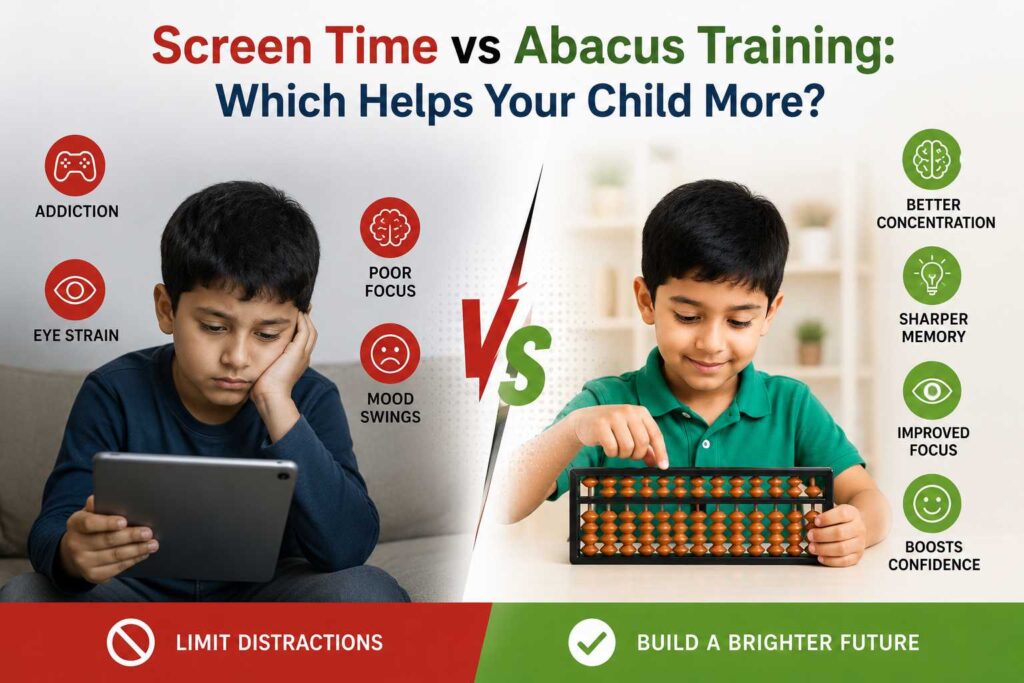
Modern parenting comes with challenges that previous generations never faced.
One of the biggest concerns for parents today is screen time.
From smartphones and tablets to video games and streaming platforms, children are spending more time in front of screens than ever before.
While technology offers educational opportunities, excessive screen exposure has raised concerns among educators, psychologists, and healthcare professionals.
At the same time, parents are actively seeking activities that support healthy brain development.
One such activity that continues to gain popularity is abacus training.
This has led many parents to ask an important question.
Should children spend more time on screens or participate in brain-development programs such as abacus training?
The answer is not as simple as completely eliminating screens.
Instead, it is about understanding how different activities impact a child’s cognitive, emotional, and academic development.
In this article, we compare screen time and abacus training to help parents make informed decisions for their children’s future.
Understanding Today’s Screen Time Reality
Technology has become an essential part of everyday life.
Children use screens for learning, communication, entertainment, and social interaction.
Many schools now incorporate digital learning platforms into their curriculum.
As a result, avoiding screens completely is neither practical nor necessary.
However, problems arise when screen usage becomes excessive.
Many children spend several hours each day watching videos, playing games, or scrolling through social media.
Over time, excessive screen exposure can affect concentration, sleep quality, physical activity, and social development.
The goal is not to eliminate technology.
The goal is to create a healthy balance.
What Happens When Children Spend Too Much Time on Screens?
Screens provide instant stimulation.
Videos change quickly.
Games deliver immediate rewards.
Social media constantly introduces new content.
While these features make digital platforms engaging, they can also affect attention spans.
Children may become accustomed to rapid stimulation.
As a result, slower activities such as reading, studying, and problem-solving can feel less interesting.
Excessive screen use may also reduce opportunities for physical play, face-to-face interaction, and creative thinking.
This is why many parents seek alternative activities that actively engage the brain.
What is Abacus Training?
Abacus training is a structured brain development program that teaches children to perform calculations using an abacus.
Students initially learn with a physical abacus.
Over time, they begin visualizing the abacus mentally.
This process develops concentration, memory, observation, visualization, and mental arithmetic skills.
Unlike passive screen consumption, abacus requires active participation.
Children must focus, think, imagine, and solve problems continuously.
This mental engagement produces significant cognitive benefits.
Passive Consumption vs Active Learning
One of the biggest differences between screen time and abacus training is the level of mental involvement.
Many forms of screen entertainment involve passive consumption.
Children watch videos or play games that require limited cognitive effort.
The brain receives information but may not actively process it deeply.
Abacus training is the opposite.
Every exercise requires concentration and mental effort.
Children actively create mental images, solve problems, and strengthen neural pathways.
This active learning approach promotes long-term cognitive development.
Impact on Concentration
Concentration is essential for academic success.
Unfortunately, many parents report that excessive screen time reduces their child’s ability to focus.
Constant exposure to fast-changing content can make sustained attention more difficult.
Abacus training directly addresses this challenge.
Students must focus carefully during calculations.
Even minor distractions can lead to errors.
Regular practice gradually strengthens attention span.
Many parents notice improved classroom focus after their children begin abacus training.
Impact on Memory
Memory is another area where abacus offers significant advantages.
Mental abacus requires children to remember numerical information while performing calculations.
This repeated exercise strengthens memory capacity.
Screen entertainment typically does not provide the same level of memory training.
While educational apps may support learning, passive content consumption often requires minimal recall effort.
Abacus consistently challenges the brain to store and retrieve information.
This helps improve both short-term and long-term memory.
Impact on Creativity and Imagination
Children naturally possess strong imaginative abilities.
Activities that encourage creativity help strengthen these skills.
Many digital activities provide ready-made visuals and instant answers.
As a result, children have fewer opportunities to create mental images independently.
Abacus training relies heavily on visualization.
Students learn to imagine the abacus in their minds and manipulate beads mentally.
This strengthens imagination and creative thinking.
The ability to visualize information can benefit children in many academic subjects.
Impact on Academic Performance
Parents often worry about how screen time affects school performance.
Research suggests that excessive recreational screen use can interfere with study habits and attention.
Abacus training supports academic growth in several ways.
Improved concentration helps children stay focused during lessons.
Enhanced memory improves information retention.
Stronger problem-solving abilities support learning across multiple subjects.
These benefits often contribute to better academic outcomes.
Impact on Confidence
Confidence develops when children overcome challenges and achieve goals.
Many digital games provide instant rewards.
While enjoyable, these rewards may not always translate into real-world confidence.
Abacus training requires effort and persistence.
Children gradually master increasingly complex calculations.
Each achievement reinforces self-belief.
As confidence grows, children become more willing to tackle difficult tasks and participate actively in class.
Social and Emotional Development
Healthy development involves more than academics.
Children also need opportunities to communicate, collaborate, and build emotional resilience.
Excessive screen use can sometimes reduce face-to-face interaction.
Children may spend less time engaging with family members and peers.
Abacus classes often involve group learning environments.
Students interact with instructors and classmates.
These experiences support communication skills and social development.
The Physical Health Factor
Extended screen use can contribute to sedentary lifestyles.
Children may spend hours sitting indoors.
Reduced physical activity can affect overall health and well-being.
Abacus training itself is not a physical activity.
However, it typically occupies only a small portion of the day.
This leaves ample time for sports, outdoor play, and other healthy activities.
Parents can create a balanced routine that includes cognitive training and physical exercise.
Does Educational Screen Time Count?
Not all screen time is harmful.
Educational content can provide valuable learning opportunities.
Interactive learning platforms, digital books, and educational videos can support development when used appropriately.
The key difference is intentional use.
Parents should focus on quality rather than quantity.
Educational screen activities combined with structured brain development programs often produce the best results.
The challenge arises when entertainment-based screen use dominates a child’s daily routine.
Why Parents Are Choosing Abacus as a Screen-Time Alternative
Many parents are searching for productive alternatives to excessive screen use.
Abacus provides a solution that is both educational and engaging.
Children enjoy the challenge of learning new skills.
At the same time, they develop concentration, memory, and confidence.
Unlike passive entertainment, abacus creates measurable developmental benefits.
Parents appreciate knowing that their child’s time is being invested in meaningful growth.
Creating a Healthy Balance
The debate should not be framed as screens versus abacus.
Technology is an important part of modern life.
Children need digital literacy skills to succeed in the future.
The real goal is balance.
Parents can establish healthy screen limits while encouraging activities that strengthen cognitive development.
Abacus training can become an important part of this balanced approach.
By combining educational technology with brain-training activities, children receive the best of both worlds.
A Practical Daily Routine
A balanced schedule might include school, homework, physical activity, family time, and limited screen use.
Abacus practice can be incorporated into this routine without creating stress.
Even fifteen to twenty minutes of daily practice can produce significant benefits over time.
Consistency is more important than duration.
Small daily efforts often lead to remarkable long-term results.
What Do Experts Recommend?
Most child development experts agree that children benefit from activities that require active thinking.
Problem-solving, visualization, memory exercises, and focused concentration support healthy brain development.
Abacus training incorporates all of these elements.
While screens can be valuable educational tools, they should not replace activities that encourage deep cognitive engagement.
Parents should prioritize experiences that help children develop lifelong learning skills.
Final Verdict: Which Helps Your Child More?
When comparing passive recreational screen time with abacus training, abacus clearly offers greater developmental benefits.
It improves concentration, memory, visualization, confidence, and problem-solving abilities.
These skills contribute directly to academic success and personal growth.
This does not mean screens are inherently bad.
Technology can be a powerful educational resource when used wisely.
However, children need activities that actively challenge and develop the brain.
Abacus training provides exactly that.
For parents seeking a meaningful way to support their child’s future, replacing a portion of daily screen time with abacus practice can be one of the most valuable decisions they make.
The goal is not to eliminate technology.
The goal is to ensure that children’s minds continue to grow, develop, and reach their full potential.
