
How Abacus Improves Memory, Concentration and Observation Skills in Children
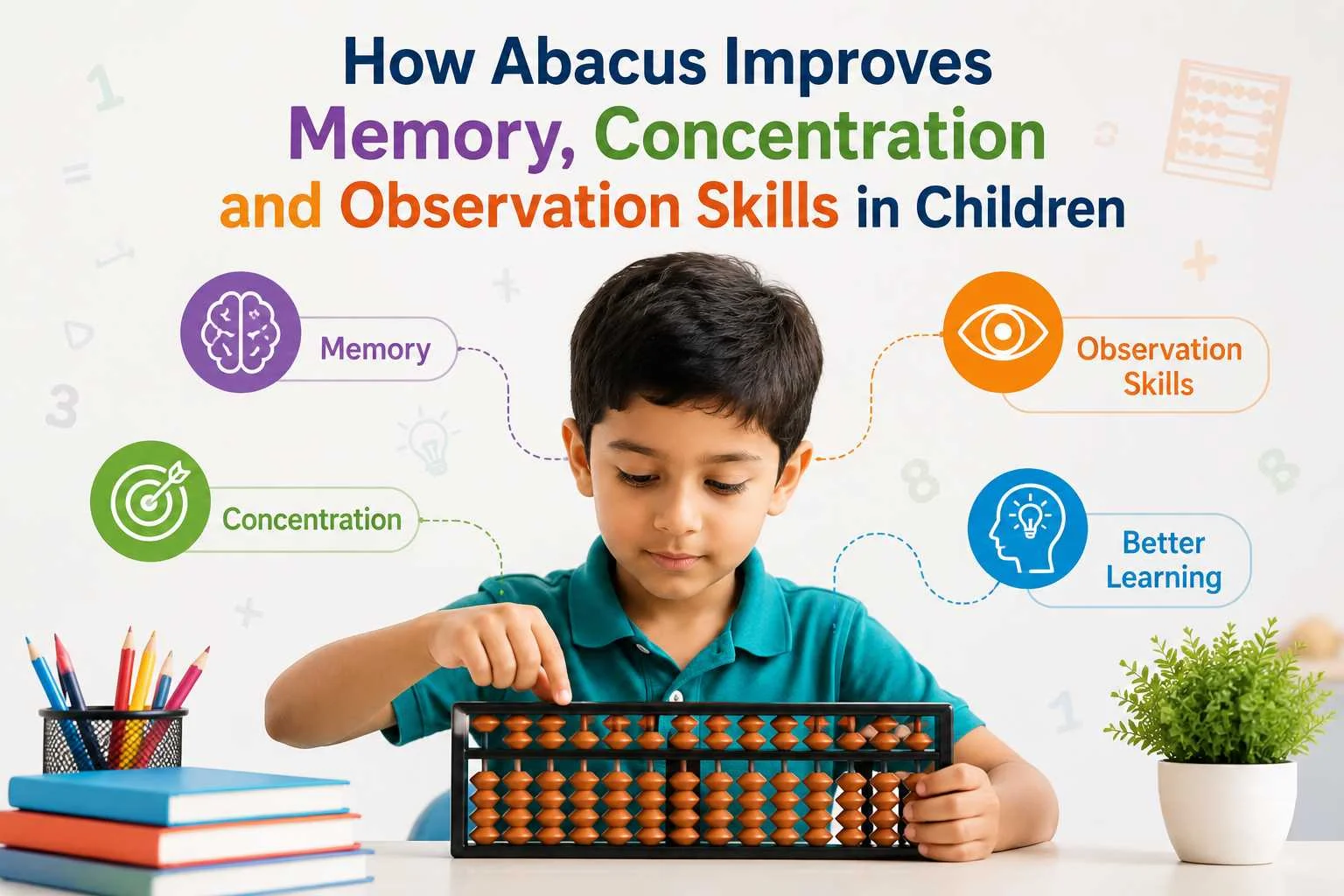
Abacus training strengthens several important mental abilities, particularly memory, concentration, and observation.
These skills form the foundation of effective learning.
In this article, we will explore how abacus training develops these essential abilities and why it can play a significant role in a child’s growth.
Why Memory, Concentration and Observation Matter
Every successful learner relies on these three cognitive skills.
Memory helps children retain information.
Concentration enables them to focus on tasks.
Observation allows them to notice details and understand patterns.
When these abilities work together, learning becomes easier and more effective.
Children who possess strong cognitive skills often perform better academically.
They process information faster and solve problems more efficiently.
These skills also support personal confidence and independent thinking.
Developing them early can provide long-term benefits.
Understanding How the Brain Learns
The brain functions like a network of connections.
Every new experience strengthens certain neural pathways.
The more frequently a skill is used, the stronger those pathways become.
Activities that challenge the brain encourage growth and adaptability.
This process is known as neuroplasticity.
Children’s brains are especially adaptable.
They can form new connections quickly and efficiently.
Abacus training takes advantage of this developmental stage.
It provides structured mental exercises that strengthen critical cognitive functions.
What Makes Abacus Unique?
Most educational activities focus on one skill at a time.
Abacus training engages multiple mental processes simultaneously.
Children must observe bead positions carefully.
They must remember numbers and calculation steps.
They must concentrate throughout the entire process.
As they advance, they begin visualizing the abacus mentally.
This activates even more areas of the brain.
The combination of these activities creates powerful cognitive stimulation.
How Abacus Improves Memory
Memory is essential for learning.
Children use memory every day when they study lessons, follow instructions, and solve problems.
Abacus training continuously challenges memory systems.
This repeated exercise strengthens memory capacity over time.
Let’s examine how this happens.
Storing Numerical Information
During calculations, students must remember multiple numbers simultaneously.
They often perform several operations before reaching the final answer.
This process exercises working memory.
Working memory is the brain’s ability to temporarily store and manipulate information.
Stronger working memory improves learning efficiency.
Mental Visualization Strengthens Recall
As students progress through abacus levels, they rely less on the physical tool.
Instead, they imagine the abacus in their minds.
They mentally move beads while solving problems.
This visualization process requires continuous memory retrieval.
Repeated practice strengthens neural pathways associated with recall.
Children gradually become better at remembering information.
Improved Academic Retention
Parents often notice that abacus students remember school lessons more effectively.
Improved memory helps children retain concepts across various subjects.
This benefit extends beyond mathematics.
Students often find it easier to remember vocabulary, instructions, and classroom discussions.
How Abacus Improves Concentration
Concentration is one of the most valuable skills a child can develop.
Without focus, even the most intelligent student may struggle academically.
Abacus training naturally strengthens attention span.
The Need for Sustained Focus
Abacus calculations require complete concentration.
A momentary distraction can result in mistakes.
Children quickly learn the importance of maintaining focus.
Regular practice gradually trains the brain to stay engaged for longer periods.
This improved concentration often transfers to schoolwork and other activities.
Reducing Mental Distractions
Modern children are exposed to constant interruptions.
Notifications, videos, and games encourage rapid shifts in attention.
Abacus provides a different experience.
It teaches children to focus deeply on a single task.
This ability becomes increasingly valuable in today’s distraction-filled environment.
Improved Classroom Attention
Teachers frequently report that children who practice abacus demonstrate stronger classroom focus.
They listen more carefully.
They complete tasks more efficiently.
They remain attentive for longer periods.
These improvements contribute directly to academic success.
How Abacus Improves Observation Skills
Observation is the ability to notice details and identify patterns.
It plays a critical role in learning and problem-solving.
Abacus training develops observation through repeated practice and attention to detail.
Recognizing Bead Positions
Students must carefully observe bead arrangements.
Small changes can significantly affect calculations.
This encourages attention to detail.
Children learn to notice subtle differences and patterns.
Pattern Recognition
Mathematics is built on patterns.
Abacus students become skilled at recognizing numerical relationships.
This ability strengthens logical thinking.
Pattern recognition also supports learning in science, language, and everyday problem-solving.
Increased Awareness
Strong observation skills help children become more aware of their surroundings.
They notice information that others may overlook.
This awareness supports learning, communication, and decision-making.
The Connection Between Memory, Concentration and Observation
These three abilities are closely connected.
Observation provides information.
Concentration allows the brain to process that information.
Memory stores it for future use.
Abacus training strengthens all three simultaneously.
This integrated development creates powerful learning advantages.
Children become more effective learners because multiple cognitive systems improve together.
The Role of Visualization in Brain Development
Visualization is one of the most important aspects of abacus training.
Mental imagery activates regions of the brain associated with creativity and memory.
Students learn to create detailed mental representations.
They manipulate these images while performing calculations.
This exercise strengthens neural communication between different brain regions.
The result is enhanced cognitive flexibility and mental agility.
How Abacus Supports Academic Success
The benefits of memory, concentration, and observation extend directly into academics.
Students who can focus better learn more efficiently.
Strong memory improves information retention.
Observation skills help identify patterns and understand concepts.
These advantages support performance across all subjects.
Many parents initially enroll their children in abacus programs to improve mathematics.
They are often surprised to see improvements in reading, science, and overall academic confidence as well.
Long-Term Benefits Beyond School
The skills developed through abacus remain valuable throughout life.
Adults rely on concentration when working on important tasks.
Memory supports decision-making and learning.
Observation helps identify opportunities and solve problems.
Children who develop these abilities early gain advantages that extend well beyond the classroom.
These cognitive skills contribute to success in higher education, careers, and personal growth.
Why Modern Children Need Cognitive Training
Technology has transformed the way children learn and interact.
While digital tools provide many benefits, they also increase distractions.
Children spend more time consuming information and less time actively processing it.
Abacus training helps restore balance.
It encourages active thinking, mental effort, and sustained focus.
These qualities are becoming increasingly important in the modern world.
Choosing the Right Brain Development Activity
Parents have many options when it comes to extracurricular activities.
Sports improve physical health.
Music develops creativity.
Art encourages self-expression.
Abacus offers something unique.
It strengthens core cognitive abilities that support every area of learning.
The combination of memory enhancement, concentration training, and observation development makes abacus one of the most comprehensive brain-training programs available.
Signs That Abacus Is Making a Difference
Parents often notice positive changes within a few months of consistent practice.
Children become more attentive.
They remember information more easily.
They complete tasks with greater focus.
Many students also show increased confidence and independence.
These improvements demonstrate how cognitive training can influence everyday life.
Final Thoughts
Memory, concentration, and observation are essential skills for academic achievement and lifelong success.
Unfortunately, these abilities are increasingly challenged by the distractions of modern life.
Abacus training provides a powerful solution.
Through visualization, mental arithmetic, and focused practice, children strengthen critical cognitive functions.
The benefits extend far beyond mathematics.
Children develop stronger learning habits, improved confidence, and enhanced mental agility.
For parents seeking a meaningful way to support their child’s intellectual growth, abacus remains one of the most effective and proven brain-development tools available today.
Investing in these cognitive skills today can help children build a stronger foundation for tomorrow.
