
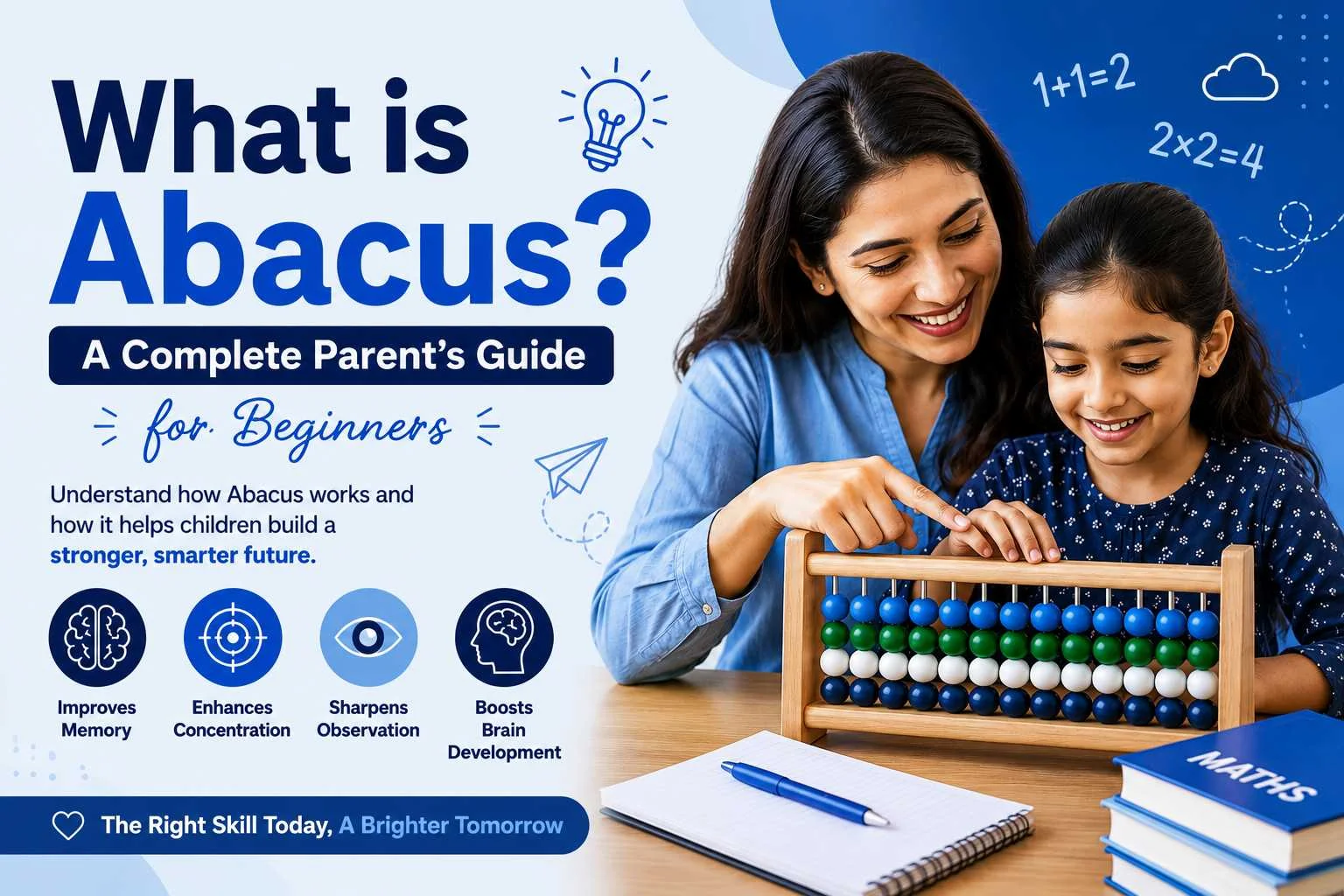
What is Abacus? A Complete Parent’s Guide for Beginners
Every parent wants to provide the best learning opportunities for their child.
In today’s digital age, children are surrounded by calculators, smartphones, and technology that can instantly solve mathematical problems.
While technology has made life easier, it has also reduced the need for mental calculations and critical thinking.
This is where abacus learning becomes highly valuable.
Abacus is much more than a simple counting tool.
It is a scientifically designed brain development program that helps children improve concentration, memory, visualization, confidence, and mental math abilities.
Many parents have heard about abacus classes but are often unsure about what exactly an abacus is and how it benefits their children.
This guide will answer all your questions and help you understand why abacus education is becoming increasingly popular worldwide.
What is an Abacus?
An abacus is one of the oldest mathematical tools used by humans.
It consists of a frame with rods and movable beads that represent numerical values.
Children learn to move these beads to perform arithmetic calculations such as addition, subtraction, multiplication, and division.
Initially, students use a physical abacus.
As they progress, they begin visualizing the beads in their minds.
Eventually, they can perform complex calculations mentally without using the physical device.
This process is known as Mental Abacus.
Mental Abacus is where the real brain development benefits begin.
The History of the Abacus
The abacus has existed for thousands of years.
Ancient civilizations in China, Mesopotamia, Greece, and Rome used various forms of counting devices.
The Chinese abacus, known as the Suanpan, became particularly popular and influenced modern abacus training methods.
Over time, educators discovered that learning abacus was not only useful for mathematics but also helped improve cognitive abilities.
Today, abacus training programs are available in schools and learning centers across the world.
How Does an Abacus Work?
The abacus uses beads placed on rods.
Each bead represents a specific numerical value.
Children learn how to move the beads to represent numbers and solve mathematical problems.
At first, calculations are performed physically.
Students gradually become familiar with number patterns and bead movements.
After sufficient practice, they start imagining the abacus in their minds.
This visualization allows them to calculate without touching the actual device.
The ability to mentally visualize and manipulate beads is what makes abacus learning unique.
Why is Abacus Different from Traditional Mathematics?
Traditional mathematics focuses on written calculations.
Students often solve problems using paper, calculators, or digital devices.
Abacus training focuses on mental processing.
Children learn to visualize numbers rather than simply memorize formulas.
This strengthens cognitive functions and encourages faster thinking.
Instead of depending on external tools, children develop the ability to calculate independently.
The result is improved confidence and better mathematical understanding.
How Abacus Helps Brain Development
One of the biggest reasons parents choose abacus training is its impact on brain development.
The human brain consists of two hemispheres.
The left brain handles logic, analysis, and numerical thinking.
The right brain handles imagination, creativity, and visualization.
Many educational systems focus heavily on left-brain activities.
Abacus training stimulates both sides of the brain simultaneously.
While solving problems, children use logic to understand numbers and visualization to imagine bead movements.
This balanced stimulation supports overall cognitive growth.
Benefits of Learning Abacus
Improves Concentration
Abacus requires complete focus.
Children must carefully observe bead positions and calculations.
Regular practice helps increase attention span and concentration levels.
This improved focus often carries over into school studies and daily activities.
Enhances Memory
Mental calculations require children to remember multiple numerical steps.
Over time, this strengthens both short-term and long-term memory.
Many parents notice improvements in their child’s ability to remember lessons and instructions.
Develops Visualization Skills
Visualization is a critical skill in learning and problem-solving.
Abacus students learn to create mental images and manipulate them.
This ability can help in mathematics, science, reading, and creative thinking.
Increases Calculation Speed
Children trained in abacus often perform calculations significantly faster than their peers.
Their mental arithmetic abilities improve through continuous practice.
This speed becomes particularly useful during exams and competitive situations.
Builds Confidence
When children can solve complex calculations mentally, they develop a strong sense of achievement.
This boosts self-confidence and encourages a positive attitude toward learning.
Improves Listening Skills
Abacus exercises often involve listening to numbers and responding quickly.
This enhances auditory processing and listening abilities.
Improved listening skills can contribute to better classroom performance.
Strengthens Problem-Solving Skills
Abacus encourages analytical thinking.
Children learn to approach problems systematically and develop logical reasoning abilities.
These skills remain valuable throughout life.
What Age Should Children Start Learning Abacus?
Most experts recommend starting abacus training between the ages of 5 and 14.
Children within this age range have highly adaptable brains.
They can absorb concepts quickly and benefit significantly from cognitive training.
The ideal starting age is usually between 6 and 10 years.
However, older children can also gain substantial benefits from learning abacus.
How Long Does It Take to Learn Abacus?
The learning duration varies depending on the program and the child’s commitment.
Basic skills can often be learned within a few months.
Developing advanced mental abacus abilities typically takes two to four years of consistent practice.
Regular training and practice are essential for achieving the best results.
Can Abacus Help Children Perform Better in School?
Yes.
Many parents report improvements in mathematics performance after enrolling their children in abacus programs.
However, the benefits often extend beyond mathematics.
Improved concentration, memory, and confidence can positively impact all academic subjects.
Children become more organized and efficient learners.
Common Myths About Abacus
Myth 1: Abacus is Only for Mathematics
Abacus certainly improves mathematical abilities.
However, its primary benefit lies in cognitive development.
Children gain improvements in memory, concentration, and visualization.
Myth 2: Only Smart Children Need Abacus
Abacus is beneficial for children of all ability levels.
The training is designed to strengthen fundamental cognitive skills.
Every child can benefit from improved focus and mental agility.
Myth 3: Calculators Make Abacus Obsolete
Calculators provide answers instantly.
Abacus develops the brain.
The objective is not simply obtaining answers but improving mental capabilities.
Myth 4: Abacus is Difficult to Learn
Modern abacus programs are designed specifically for children.
The learning process is structured, engaging, and easy to follow.
How to Choose the Right Abacus Program
Look for a program with a structured curriculum.
Qualified instructors are equally important.
Ensure that the learning environment is supportive and engaging.
Regular assessments and practice opportunities can help children progress effectively.
Parents should also consider programs that focus on overall brain development rather than just calculation speed.
The Future Relevance of Abacus
Many people assume mental arithmetic is less important because technology is everywhere.
In reality, skills such as concentration, memory, creativity, and problem-solving are becoming more valuable than ever.
These abilities cannot be replaced by calculators or artificial intelligence.
Abacus training develops precisely these skills.
This makes it highly relevant for future academic and professional success.
Final Thoughts
Abacus is far more than a counting tool.
It is a comprehensive brain development program that enhances concentration, memory, visualization, confidence, and mathematical abilities.
For parents seeking a meaningful way to support their child’s intellectual growth, abacus training offers proven benefits that extend well beyond mathematics.
By investing in abacus education today, parents can help their children build skills that will benefit them throughout their academic journey and future careers.
