
At What Age Should a Child Start Learning Abacus? A Complete Age-Wise Guide for Parents
One of the most common questions parents ask before enrolling their child in an abacus program is, “What is the right age to start learning abacus?”
Every parent wants to ensure that their child begins learning at the perfect time.
Starting too early may overwhelm the child, while starting too late may reduce some of the developmental advantages that come with early cognitive training.
The good news is that abacus learning can benefit children across different age groups.
However, certain ages are considered ideal because of the way children’s brains develop during their early years.
In this guide, we will explore the best age to start abacus training, the benefits at different age levels, and how parents can determine whether their child is ready.
Why Age Matters in Abacus Learning
A child’s brain develops rapidly during the early years.
Neuroscience research has shown that the majority of brain growth occurs before adolescence.
During this period, children are highly receptive to new skills and learning experiences.
Their brains create and strengthen neural connections much faster than adults.
This is why childhood is considered the ideal time for learning languages, music, sports, and cognitive skills.
Abacus training takes advantage of this natural learning ability.
The earlier a child develops concentration, visualization, and mental arithmetic skills, the stronger those abilities can become over time.
Understanding Brain Development in Children
Children do not learn the same way at every age.
Their attention span, memory, problem-solving ability, and emotional maturity evolve as they grow.
An activity that is perfect for an eight-year-old may not be suitable for a four-year-old.
Abacus programs are designed with these developmental stages in mind.
The goal is not simply to teach calculations.
The objective is to strengthen brain functions while keeping learning enjoyable and age-appropriate.
Understanding how children develop helps parents choose the right time to begin.
Can Children Below 5 Years Learn Abacus?
Many parents are eager to start their child’s learning journey as early as possible.
While children below five years can recognize numbers and simple counting patterns, formal abacus training is usually not recommended.
Young children at this stage are still developing basic attention skills.
They often struggle to sit for extended periods and follow structured instructions.
Their fine motor skills are also still developing.
Introducing abacus concepts too early may lead to frustration rather than enjoyment.
Instead, parents should focus on number games, puzzles, storytelling, and simple counting activities.
These activities create a strong foundation for future abacus learning.
The Ideal Age: 5 to 7 Years
Most abacus experts consider ages five to seven as an excellent starting point.
Children at this stage are naturally curious and enthusiastic learners.
Their brains are highly adaptable and capable of absorbing new concepts quickly.
They can understand numerical relationships more effectively than younger children.
They also have sufficient concentration to participate in structured learning sessions.
Abacus training introduced during this age can significantly improve memory, focus, and observation skills.
Children often enjoy moving the beads and solving problems in a playful environment.
This positive experience encourages long-term engagement.
Why Ages 6 to 10 Are Considered the Golden Years
Many educators refer to ages six to ten as the golden period for abacus training.
During these years, children develop stronger visualization abilities.
Visualization is one of the most important skills in mental abacus learning.
As students progress, they stop depending on the physical abacus.
Instead, they imagine the abacus in their minds and perform calculations mentally.
Children between six and ten typically develop this skill more naturally than older learners.
Their ability to create mental images supports faster progress and stronger cognitive benefits.
This age group also experiences rapid growth in memory and analytical thinking.
Abacus training complements these developmental changes perfectly.
Can Children Aged 11 to 14 Learn Abacus?
Absolutely.
Many parents worry that their child has missed the opportunity if they start later.
Fortunately, abacus remains highly beneficial for older children.
Students between eleven and fourteen can still improve concentration, calculation speed, and problem-solving abilities.
Older children often understand mathematical concepts more quickly.
They may progress through the initial stages faster than younger students.
However, younger learners usually have a slight advantage when it comes to developing visualization skills.
This does not mean older children cannot succeed.
With regular practice and dedication, they can achieve excellent results.
Benefits of Starting Abacus at an Early Age
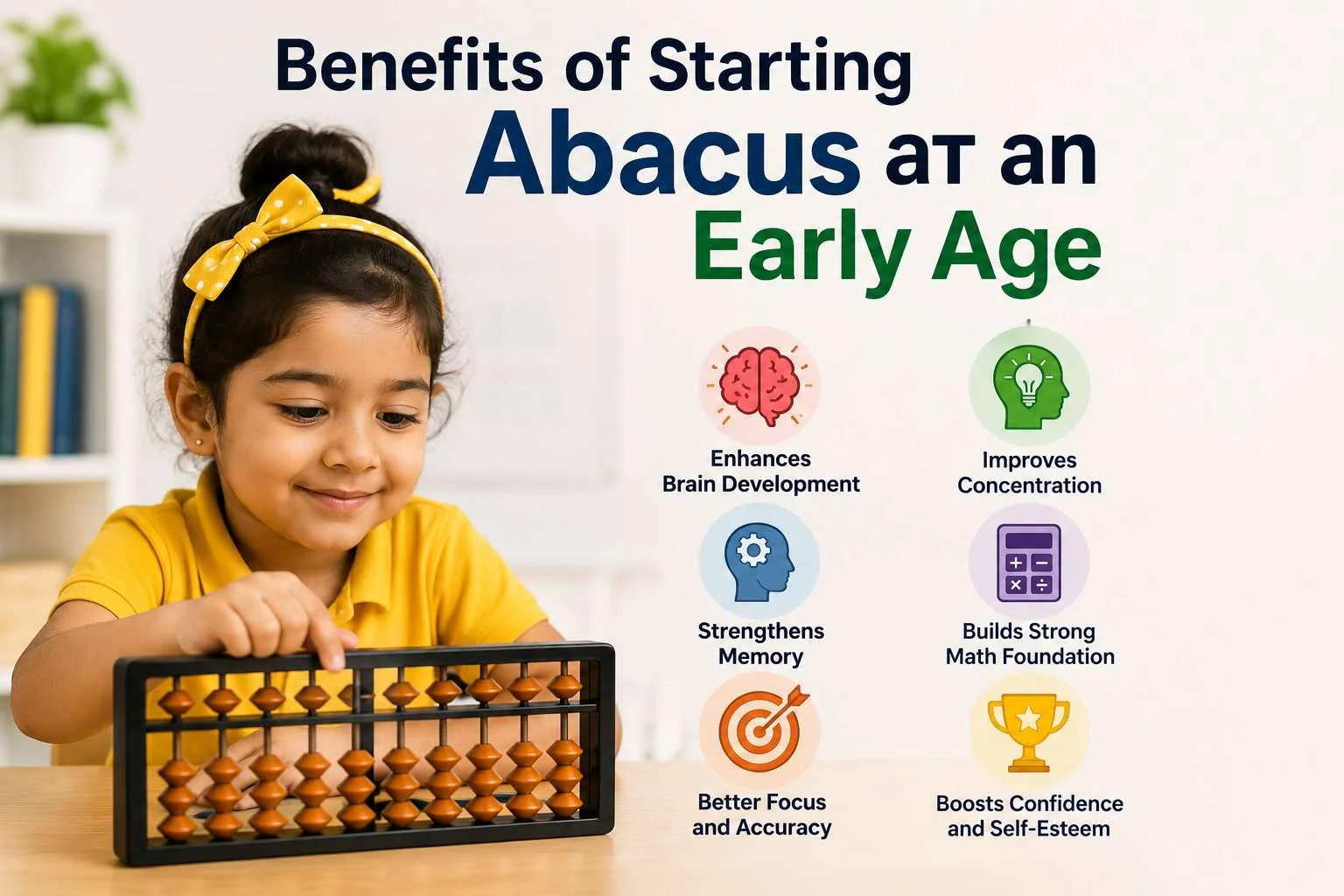
Children who begin abacus training during their early years often experience long-term advantages.
The skills developed through abacus become deeply integrated into their learning habits.
They develop stronger focus and attention spans.
They become more confident when solving problems.
They often perform calculations with greater speed and accuracy.
Many students also demonstrate improved memory and classroom participation.
These benefits continue to support academic success throughout school life.
How Abacus Supports Academic Growth
Parents often enroll their children in abacus programs because they want to improve mathematics performance.
While abacus certainly helps with numerical skills, its impact extends much further.
Children who practice abacus regularly develop better concentration.
They become more attentive during lessons.
Their improved memory helps them retain information more effectively.
Their confidence encourages active participation in classroom discussions.
These advantages contribute to overall academic improvement.
Signs Your Child is Ready for Abacus
Every child develops at a different pace.
Instead of focusing solely on age, parents should look for readiness indicators.
A child may be ready for abacus if they can recognize numbers comfortably.
They should be able to follow basic instructions.
They should show curiosity about counting and numerical activities.
The ability to sit and focus for short periods is also helpful.
Children who enjoy puzzles, games, and learning challenges often adapt quickly to abacus training.
Common Parent Concerns
Will Abacus Put Extra Pressure on My Child?
A well-designed abacus program should never feel stressful.
Classes are structured to be engaging and interactive.
Children learn through activities, practice exercises, and friendly challenges.
The emphasis is on gradual improvement rather than perfection.
What If My Child Is Weak in Mathematics?
Abacus is often especially beneficial for children who struggle with mathematics.
The visual and hands-on approach helps make numbers easier to understand.
Many children develop a more positive attitude toward math after beginning abacus training.
How Long Should Children Practice?
Consistency is more important than duration.
Even fifteen to twenty minutes of daily practice can produce excellent results.
Regular practice strengthens neural pathways and improves skill retention.
Why Parents Should Not Delay Too Long
While there is no strict age limit for learning abacus, starting earlier generally provides more opportunities for development.
The brain’s ability to absorb and adapt to new learning experiences is strongest during childhood.
Beginning abacus training during these years allows children to maximize cognitive growth.
Waiting too long may mean missing some of the benefits associated with early brain development.
However, parents should remember that it is never too late to start.
Every stage of learning offers valuable opportunities for growth.
Choosing the Right Abacus Program
Selecting the right program is just as important as choosing the right age.
Look for experienced instructors and a structured curriculum.
The program should focus on both mental arithmetic and overall brain development.
Interactive lessons and regular assessments can help maintain student motivation.
Parents should also choose a learning environment where children feel encouraged and supported.
The Long-Term Impact of Early Abacus Learning
Children who begin abacus training at the right age often carry the benefits into adolescence and adulthood.
They develop stronger concentration habits.
They become more confident learners.
Their ability to process information quickly can support academic and professional success.
Many students continue to rely on visualization and mental calculation techniques long after completing their abacus courses.
These skills become lifelong assets.
Final Thoughts
The best age to start learning abacus is generally between five and ten years.
This period provides the ideal balance of brain development, attention span, and learning readiness.
Children in this age group can absorb concepts quickly and develop powerful visualization skills.
However, abacus remains beneficial for older children as well.
The most important factor is not finding the perfect age.
It is providing children with opportunities to strengthen their concentration, memory, confidence, and problem-solving abilities.
Abacus training offers all of these benefits and much more.
For parents seeking a meaningful investment in their child’s future, starting abacus at the right age can be one of the most rewarding decisions they make.
