
Can Abacus Improve Academic Performance Across Subjects?
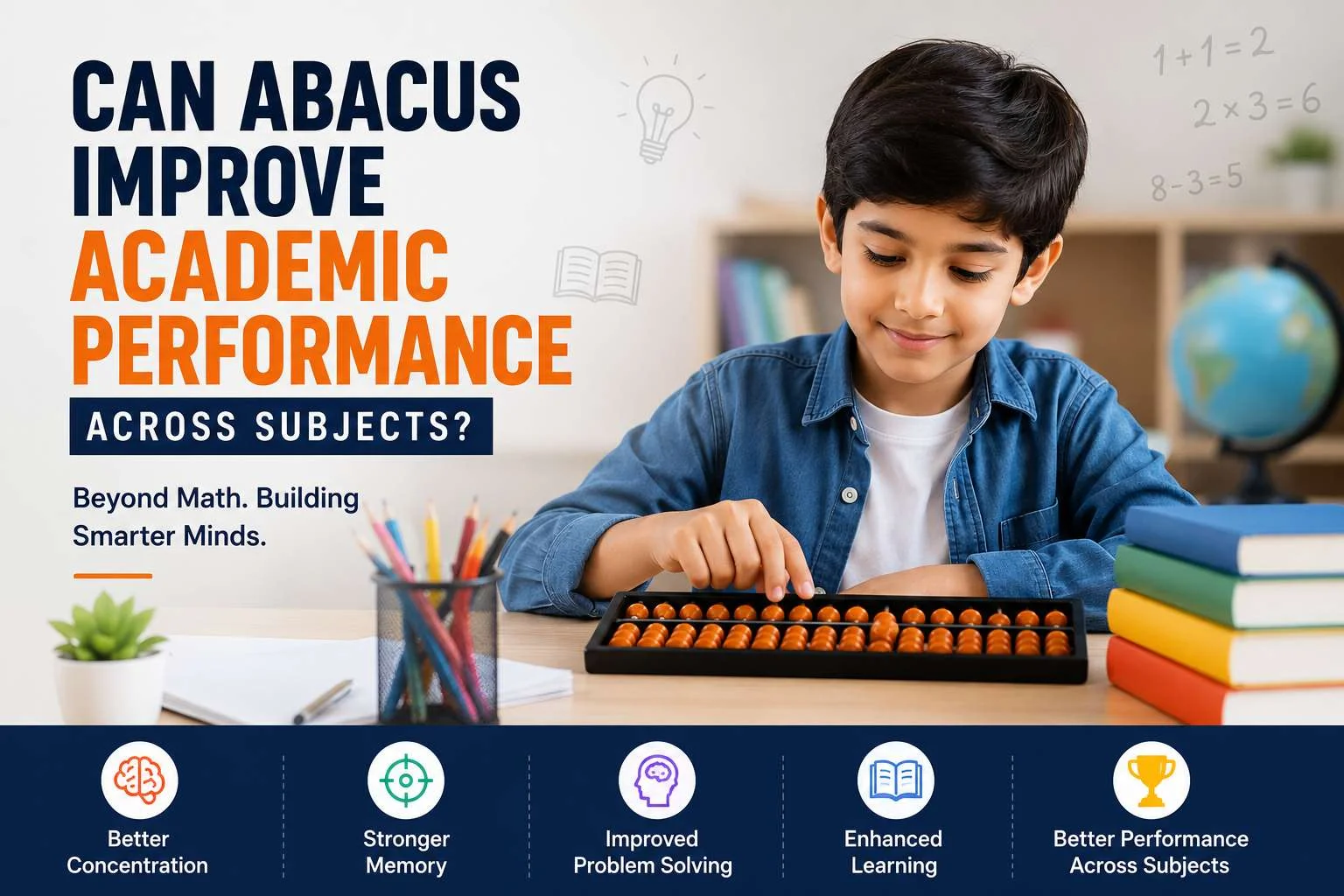
When parents hear about abacus training, they often associate it with mathematics.
After all, the abacus is a calculation tool designed to help children perform arithmetic operations quickly and accurately.
However, many parents are surprised to discover that the benefits of abacus extend far beyond mathematics.
In fact, one of the most common observations among parents and teachers is that children who learn abacus often show improvements in multiple academic subjects.
This raises an important question.
Can abacus actually improve overall academic performance?
The answer is yes.
While abacus directly strengthens mathematical abilities, it also develops several cognitive skills that influence success across all areas of learning.
These include concentration, memory, observation, visualization, listening skills, confidence, and problem-solving abilities.
In this article, we will explore how abacus training contributes to better academic performance and why it has become one of the most trusted brain development programs for children.
Academic Success Requires More Than Intelligence
Many people assume that academic achievement depends solely on intelligence.
In reality, successful students possess a combination of skills.
They can focus for extended periods.
They remember information effectively.
They solve problems confidently.
They stay organized and attentive in the classroom.
These abilities often determine success more than natural intelligence alone.
Abacus training strengthens many of these critical learning skills.
As a result, children become better learners overall.
Understanding How Children Learn
Every child processes information differently.
However, most learning involves three important stages.
The first stage is attention.
Children must focus on the information being presented.
The second stage is retention.
They must store the information in memory.
The third stage is recall and application.
They must retrieve the information and use it effectively.
Abacus training strengthens each of these stages.
This is one reason why its benefits extend across multiple subjects.
How Abacus Improves Concentration
Concentration is one of the most important factors in academic performance.
Children who struggle to focus often miss important information during lessons.
Even small lapses in attention can affect learning outcomes.
Abacus calculations require complete focus.
Students must observe bead movements carefully and maintain concentration throughout the exercise.
With regular practice, their attention span gradually increases.
Many parents notice that their children become more attentive during homework and classroom activities.
Improved concentration supports better performance in every subject.
Stronger Memory Leads to Better Grades
Memory is essential for academic success.
Students must remember formulas, vocabulary, concepts, historical facts, and scientific principles.
Abacus training constantly challenges memory systems.
Children must remember numbers, calculation sequences, and visualized bead positions.
This repeated exercise strengthens working memory and long-term memory.
As memory improves, children find it easier to retain classroom lessons.
This often translates into stronger academic results.
The Role of Visualization in Learning
Visualization is a powerful learning tool.
Many successful students naturally create mental images when studying.
Abacus training develops this ability through mental arithmetic exercises.
As children progress, they begin imagining the abacus in their minds.
They manipulate virtual beads while solving calculations.
This strengthens visualization skills significantly.
Visualization supports learning in mathematics, science, geography, reading comprehension, and creative writing.
Children become more capable of understanding complex concepts through mental imagery.
Better Listening Skills in the Classroom
Listening is an often-overlooked academic skill.
Students who listen carefully understand instructions more clearly and absorb lessons more effectively.
Many abacus exercises involve listening to numbers and responding quickly.
Children learn to pay close attention and process information accurately.
These improved listening skills frequently carry over into school environments.
Teachers often notice that abacus students follow instructions more effectively and participate actively during lessons.
Improved Mathematics Performance
Mathematics is naturally the area most directly influenced by abacus training.
Students develop stronger number sense and mental calculation abilities.
They become faster and more accurate when solving arithmetic problems.
Confidence in mathematics increases significantly.
Children who once struggled with numbers often develop a more positive attitude toward the subject.
Improved mathematical confidence can have a lasting impact on academic performance.
Benefits in Science Subjects
Science requires observation, analysis, and logical thinking.
These are skills that abacus training actively develops.
Students learn to identify patterns and process information systematically.
Their improved concentration helps them follow scientific explanations more effectively.
Memory improvements support the retention of scientific concepts and terminology.
As a result, many students experience stronger performance in science subjects.
Benefits in Language Learning
At first glance, language subjects may seem unrelated to abacus.
However, many of the cognitive skills developed through abacus directly support language learning.
Improved memory helps students remember vocabulary and grammar rules.
Better concentration supports reading comprehension.
Enhanced listening skills improve communication abilities.
These advantages contribute to stronger language development and academic success.
Benefits in Social Studies
Subjects such as history and geography require extensive information retention.
Students must remember dates, locations, events, and concepts.
Strong memory plays a critical role in success.
Abacus training strengthens memory systems through continuous mental exercise.
Children become more capable of retaining large amounts of information.
This supports performance in social studies and other content-heavy subjects.
Building Problem-Solving Skills
Every academic subject involves problem-solving.
Students must analyze information, identify patterns, and reach conclusions.
Abacus encourages logical thinking and systematic problem-solving.
Children learn to approach challenges methodically.
These skills help them solve mathematical problems, interpret scientific data, and analyze written information more effectively.
Problem-solving abilities are valuable throughout life.
Increased Confidence in Learning
Confidence has a significant impact on academic performance.
Children who believe in their abilities are more likely to participate, ask questions, and tackle difficult tasks.
Abacus training provides regular opportunities for achievement.
As students master increasingly complex calculations, their self-confidence grows.
This confidence often extends into other academic areas.
Children become more willing to embrace challenges and pursue success.
Reducing Academic Anxiety
Many students experience stress when facing difficult subjects.
Mathematics is a common source of anxiety.
Abacus helps children build competence and confidence gradually.
As their abilities improve, fear and frustration often decrease.
This positive mindset supports healthier learning experiences and better academic outcomes.
How Abacus Encourages Independent Learning
Successful students are often independent learners.
They take responsibility for their studies and seek solutions independently.
Abacus training encourages self-reliance.
Children learn to trust their own thinking processes.
They become less dependent on calculators and external assistance.
This independence contributes to stronger academic habits.
The Long-Term Academic Advantage
The cognitive benefits of abacus continue long after formal training ends.
Children carry their improved concentration, memory, and problem-solving skills into future educational experiences.
These abilities support success throughout secondary school, higher education, and professional life.
The skills developed through abacus become lifelong assets.
What Teachers Often Notice
Many teachers observe positive changes in students who participate in abacus programs.
These children often appear more attentive during lessons.
They complete assignments with greater focus.
They demonstrate stronger numerical abilities and improved confidence.
Teachers frequently report better classroom participation and engagement.
These observations support the broader educational benefits of abacus training.
Why Modern Students Need Cognitive Training
Today’s children face more distractions than any previous generation.
Digital devices compete constantly for attention.
Maintaining focus has become increasingly challenging.
Abacus training provides structured mental exercise that strengthens essential cognitive abilities.
It helps children develop the focus and discipline required for academic success.
These skills are becoming more valuable in the modern educational environment.
Can Abacus Replace School Learning?
No.
Abacus is not a substitute for school education.
Instead, it acts as a powerful supplement.
It strengthens the mental skills that make learning easier and more effective.
Think of abacus as a gym for the brain.
Just as physical exercise improves athletic performance, cognitive training improves learning performance.
The stronger the brain becomes, the more effectively children can learn.
Final Thoughts
Academic success depends on much more than mathematical ability.
Students need concentration, memory, observation, confidence, and problem-solving skills to perform well across subjects.
Abacus training develops all of these essential abilities.
While its impact on mathematics is well known, its benefits extend into science, language learning, social studies, and overall classroom performance.
Children become stronger learners because their cognitive foundation becomes stronger.
For parents looking to support their child’s academic journey, abacus offers one of the most effective ways to build the skills that drive long-term educational success.
The benefits go far beyond numbers.
They help children become confident, focused, and capable learners ready to excel in every subject they encounter.

Great content! Keep up the good work!
Thank you so much @ExoWatts